I generated a landing page, looked at it, and felt nothing. Not because it was bad – it was fine. But fine is the problem. Here I share what that hollow feeling is actually telling us, why designing is thinking and not just making, and how I’ve been finding a new approach that still lets me stand behind my work. Because typography might be the sharpest tool in a world of AI-generated design.
Hollow and replaceable
There’s this feeling of disappointment and overwhelm I get when generating web or app designs using AI tools. No matter if it’s Google Stitch, v0, or Figma Make. I’m so distracted by the result that I forget what I’m actually looking at, even what I actually wanted this to be designed for. Is this what I wanted? Is it good or bad? In some places it is obviously not working, in others it is impressively well done. But overall it often has a hollow aftertaste, feels generic, like a mock-up with no soul.
Which brings me to the question – what should good design actually feel like? To have substance, it needs to connect all the pieces: intent, content, and shape. Form follows function, function follows feeling. To me, good design doesn’t only look appealing, it makes people want to spend time with it, while helping them achieve their goals.
Avoiding thinking
The problem with using AI tools is that they often pull me towards not wanting to think, because the instant results make it easy to avoid confronting myself with a topic. And frankly, I often don’t want to invest in analyzing the generated designs. When they come out so effortlessly, it makes them feel almost worthless. But of course they are not, as so much is happening in the background making it appear this easy.
The machine is so fast in creating a result that my thinking has not caught up with it – the design is shaped, my opinion towards it isn’t. AI is fast, humans aren’t.
However, being fast doesn’t have value in itself when you’re racing in the wrong direction. But what does the right direction actually look like? How did I decide that before using AI tools?
Designing is thinking
Before AI tools, getting to a result took more work and time. During that, I confronted myself with a topic, I shaped the design, and while doing that it shaped my thinking. In that process I filled the empty canvas with often fictitious, but realistic content. Then I modeled it, applying a certain visual aesthetic and asked myself: Does this look fit the project? If not, what needs to change?
- Do content and design work together (connecting)?
- Is information in the right order (hierarchy)?
- What’s missing and what’s too much (clarity)?
- How could I communicate this better (effectiveness)?
- Does it work with different content (flexibility)?
When I was happy with the result, I cleaned it up and went through my designs again, trying to use as few components as possible. Not just to make it easier to implement and maintain, but also to make it clearer. Because by only using a few repeating elements within a design it also gets more obvious to the user what certain parts are intended for.
This process was essential to me to get to a quality result. One that ensures that what I create is sound. Now with AI tools, I have to adjust my approach. It also has to make sure that I confront myself with a topic and that I can wholeheartedly stand behind the result, AI-generated or not.
A new approach
The disappointment or irritation when looking at a generated design comes from my wrong expectation of seeing something thoughtful and finished. I can only evaluate both things when I know what thoughtful or finished mean. In that sense I still need to shape my opinion. Some people call this “taste”, Patricia Reiners put it better by calling it judgment on her podcast (at 14:15). You need to have experience and empathy to judge if something is appropriate or not. So what can a better approach look like?
1. Think longer about my prompt
Be as clear as possible about the structure, intent, and visual appeal of a project at the beginning. The more specific your prompt is, the better the result will be. The more time you spend describing what you want, the more it will shape your opinion and make it possible for you to judge it. To me this is less fun than doing it during a visual design process, but I can accept it, because the visual part still follows.
2. What’s generated is not finished
These tools are so fast, they tend to rush you. So take a step back, take a breath, and more time to look at it closely. And don’t be fooled by the eye candy. What you’re looking at is still a rough template – with amazing hover effects.
What helps me here is thinking of it as an average designer’s output. The question now is: How can I turn this into something outstanding? And that’s simply by asking myself the same questions from the process before: Does this look fit the project? If not, where do I need to change it?
3. Bringing it together
My value as a human designer is putting the design into context by having empathy, understanding its meaning, assessing its appeal and functionality, and correcting its misdirections. My work moves from designing from scratch to reworking what was generated. This can be a bit frustrating, but it is also a learning experience to sharpen my judgment and lean more into that.
But now let’s get to typography and what role it plays in this new approach. It actually becomes more important.
Typography is what ties it together
No matter if a design is AI-generated or not, type is still everywhere. And typography gives a product personality while emphasizing its functionality. And the same typographic rules still apply.
AI models were trained on the average of the web. So they repeat mediocrity by imitating generic cookie-cutter templates and often using the same Google Fonts. Almost always Inter is their primary type choice. And when you want something more interesting, they often go too wild, creating designs that aren’t very usable. Because they also recreate common mistakes, like inappropriate font choices, weak hierarchy, and inaccessible color contrast.
In this sea of good-enough designs, the thoughtful and intentional ones become a beacon. And these always need a human designer to judge and finesse them.
Here typography makes you start thinking again. Because you can only make content communicate at its best when making it clear. And typography instantly shows you where things are off. Following a clear hierarchy while keeping it interesting, makes all the difference if someone will be tempted to read it or skip it.
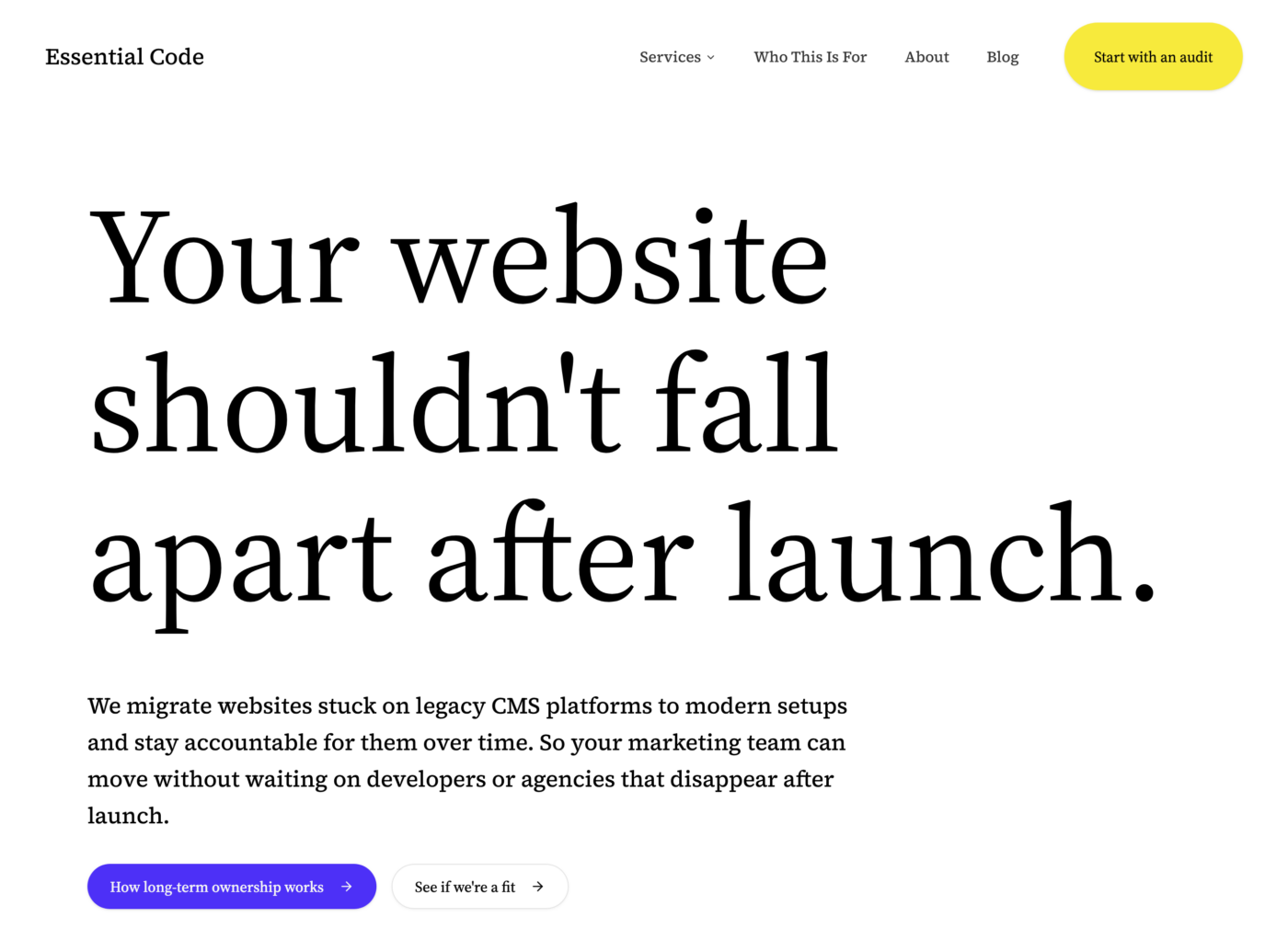
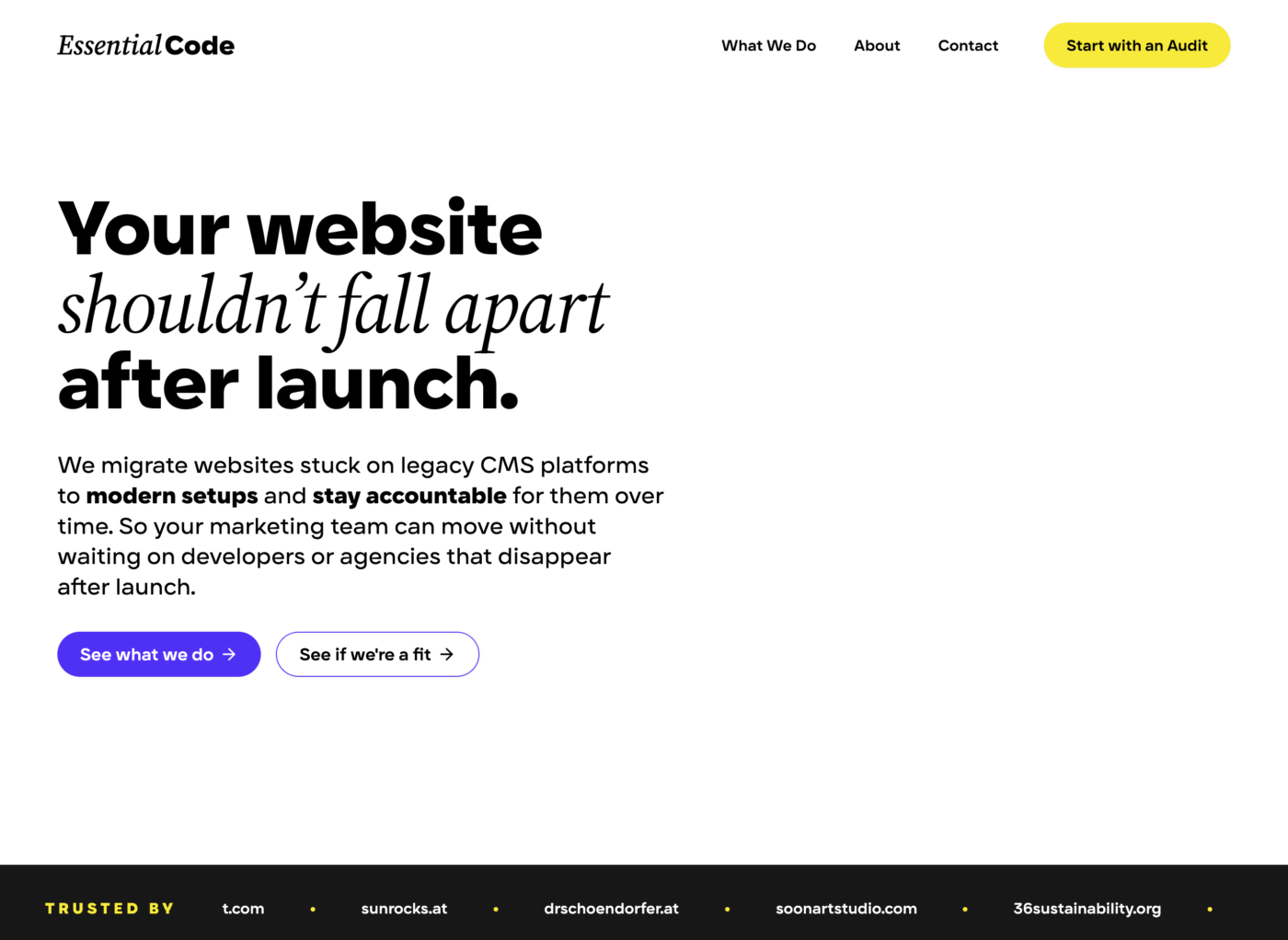
I will share a case study where I assess and rework the typography of an AI-generated landing page soon. But here is short glimpse of it. While the foundation was solid, the execution was not.
I have not found my groove yet
Even though I feel I’m heading in a good direction, I am still struggling and learning a lot. These are my biggest challenges to me right now.
I miss the manual exploration of styles, the thinking and taking my time. Starting from an empty canvas and not from a prompt. But maybe that’s because I’m not used to exploring by generating styles. And I can also see that this will become more fun the more I use it.
I’m feeling more stressed than before, despite getting more done faster. With tools that instantly produce results, it makes me want to instantly judge. When actually I need to remind myself to slow down and think.
I feel overwhelmed, every time a new tool comes out, or something new is hyped. My first reaction is that I’m falling behind, this will not empower me, it will take the thing away from me that I love most – designing. I need to remind myself that I’m not afraid of the tool, I’m just overwhelmed by the pace of change. And that it gives me the opportunity to reflect on what I’m truly good at and what I enjoy doing.
For now, I come to the conclusion that when I’m working with generated designs I need a slightly different approach and mostly different mindset, while still answering the same old questions. Things are still moving very fast, and I might change my opinion in the future. But writing this down already gave me more clarity on what my opinion and approach towards it are.
And now I’m curious about your thoughts. How have you incorporated AI-generated designs into your workflow, and how do you see it? Let me know in the comments!
Oliver, I resonate with your observations, and AI is a double edged sword, but I want to share something hopefully inspiring:
Ai is giving us designers the ability to build new things. We suddenly don’t have to code anymore, which is a huge bottleneck for creative people.
Before, creatives already manipulated code. But it was hidden from us through software and interfaces. They acted like the middle man, between our creative vision and the underlying code.
Now we have for the first time direct access to the underlying code without having to learn all those crazy ass languages.
I’m no coder, my brain doesn’t work like that, especially not when doing creative things. But now I got this ai translator between human thinking and machine thinking, who can execute my designer speak into production code.
And with using code to design, I don’t mean just apps and websites. You can do a lot of very cool and very creative things through code. Right now I’m using html/css/javascript to build motion design templates. (All without motion design programs, or editing software).
Yes, junior designers might suffer at first because, they are the workforce that’s at risk (for now), but Creative Directors and Art Directors, are getting supercharged to bring their creative vision into reality.
Ai is gonna raise the bar. For everyone who works on the computer, I mean, who isn’t gonna be impacted?
This is what’s gonna happen: Great is gonna become the new good. And for most that will be good enough. We as designers are getting asked to be better than that, to do bigger things, to have bigger visions, and to raise the new standard even higher. To define the new great while everyone else doing stuff that is good enough.
I mean literally producing mind blowing things, that were not possible before.
I love that positive remark, Silvan! And I have to agree. It will create so much better prototypes and gives us possibilities now to visualize ideas and concepts much more concrete. I already experienced that when I was consulting a client this week. They needed alternative fonts and I made them a prototype showing the fonts in action, real web fonts, not a Figma prototype. And it was very easy to do for me 😊. Seems my fear is mostly from not trying out enough 😉.